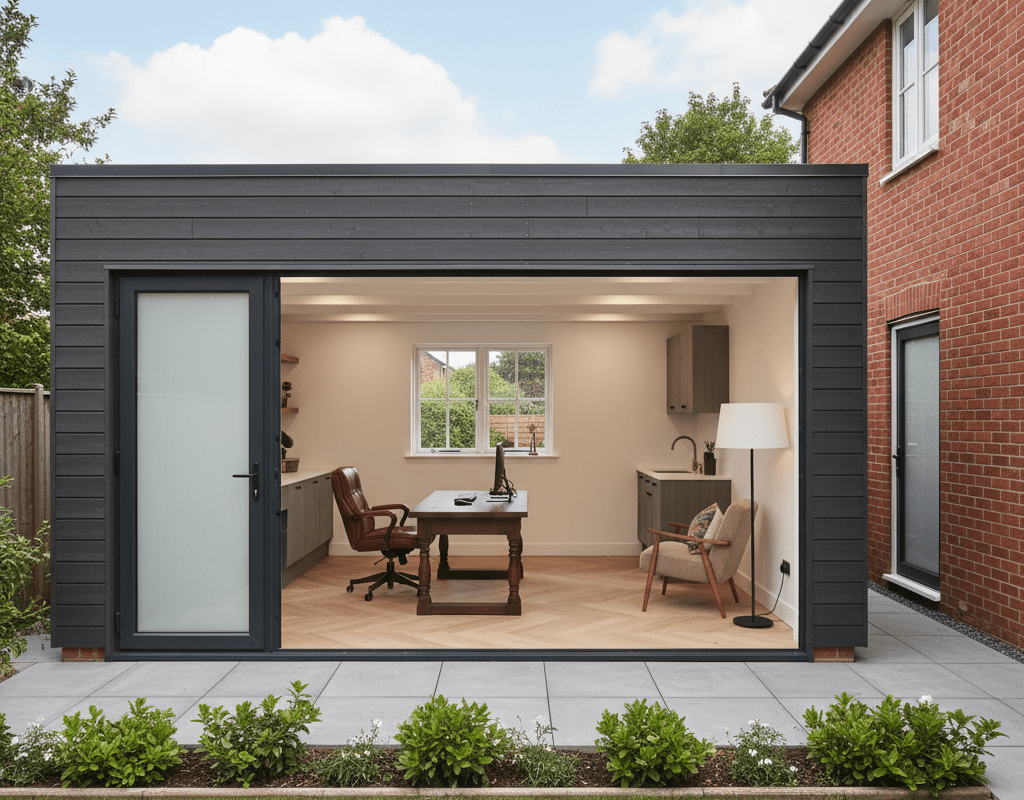


Building Net Zero house extensions UK has become the gold standard for homeowners in London and Manchester this year. With the 2026 updates to the Future Homes Standard, achieving a carbon-neutral footprint is now both a legal necessity and a smart financial investment.
Today, homeowners are prioritising long-term energy security over traditional aesthetics. Our guide explores how to navigate the latest regulations while creating a beautiful, sustainable living space.
Understanding Net Zero House Extensions UK in 2026
A Net Zero extension is designed to produce as much energy as it consumes over the course of a year. This involves a fabric-first approach to ensure the structure is airtight and thermally efficient from the ground up.
You can explore our full range of house extensions to see how we integrate these sustainable principles into every London project. We focus on reducing embodied carbon through reclaimed materials and low-impact site management.
Navigating Part L Compliance and Building Regulations
Strict adherence to Part L compliance is mandatory for any modern renovation project in the UK. This regulation dictates the maximum energy allowances and minimum efficiency standards for all new thermal elements.
Failure to meet these standards can result in significant legal hurdles and decreased property value. Our team ensures that every design meets the latest architectural planning criteria for Net Zero status.
Key Part L Requirements for 2026
* Mandatory pressure testing for all extensions over 30 square metres.
* Detailed photographic evidence of insulation installation to prevent thermal bridging.
* Standardised carbon emission targets that are 30% stricter than 2021 levels.
Meeting the U-Value Requirements 2026
The U-value requirements 2026 have pushed the boundaries of traditional construction methods. These values measure the rate of heat transfer through walls, roofs, and floors.
Lower U-values mean better insulation and lower heating bills for the homeowner. To achieve these targets, we often recommend high-performance loft conversions that utilise advanced vacuum insulation panels.
Recommended U-Value Targets
- Walls: 0.15 W/m²K or lower.
- Roofs: 0.11 W/m²K to ensure maximum heat retention.
- Floors: 0.13 W/m²K using insulated raft foundations.
- Windows: Triple glazing with a maximum value of 0.8 W/m²K.
The Role of Sustainable Insulation
Selecting sustainable insulation is the most effective way to reduce the embodied carbon of your build. Natural materials like wood fibre, hempcrete, and sheep’s wool are now the preferred choice for UK architects.
These materials offer excellent breathability, which prevents damp issues in airtight Net Zero homes. They also provide superior acoustic performance compared to traditional synthetic foams.
Benefits of Natural Insulation
* High thermal mass helps regulate indoor temperatures during summer heatwaves.
* Carbon sequestration properties help offset the project’s overall footprint.
* Non-toxic composition ensures improved indoor air quality for your family.
Transitioning to Low Carbon Heating Systems
In 2026, the UK has moved away from gas boilers entirely for new extensions. Low carbon heating solutions like air-source heat pumps (ASHPs) and infrared heating panels are now the industry standard.
These systems work most efficiently when paired with underfloor heating. This setup allows for lower flow temperatures, which significantly reduces electricity consumption.
Popular Low Carbon Options
* Air-Source Heat Pumps: Highly efficient units that extract heat from the outside air.
* Solar Thermal: Panels that directly heat your domestic hot water using sunlight.
* Mechanical Ventilation with Heat Recovery (MVHR): Essential for maintaining fresh air in airtight Net Zero builds.
Smart Home Integration for Energy Monitoring
True Net Zero living requires real-time data to manage energy production and consumption. Smart home systems now include AI-driven dashboards that optimise battery storage and EV charging.
These systems ensure you are using solar energy when it is most abundant. This technology is a core component of any home renovation focused on 2026 sustainability goals.
The Financial Case for Net Zero
While initial build costs may be 10-15% higher, the long-term savings are undeniable. Net Zero homes in the Cotswolds and Birmingham are currently fetching a 20% premium on the open market.
Reduced energy bills provide a hedge against future utility price volatility. Furthermore, many UK lenders now offer ‘Green Mortgages’ with lower interest rates for Net Zero certified properties.
Checklist for Your Net Zero Project
* Conduct a site-specific solar gain analysis during the design phase.
* Specify FSC-certified timber and low-carbon concrete alternatives.
* Ensure your contractor is experienced with airtightness membranes and tapes.
* Verify that all glazing units are Argon-filled and feature Low-E coatings.
* Install smart meters and energy monitoring hardware from day one.