

Acoustic Dry Lining for Home Pods 2026: The Professional UK Guide
Optimising your property with acoustic dry lining for home pods 2026 is no longer a luxury but a necessity for the modern hybrid professional. As we move deeper into the decade, the demand for high-performance sound isolation in residential spaces has reached an all-time high.
In-Hire is at the forefront of this shift, providing the specialist equipment and expertise needed to meet the stringent 2026 Future Homes Standard. Whether you are building a backyard office or a recording suite, understanding the mechanics of sound transmission is essential for a successful project.
The Evolution of Soundproof Partitioning UK Standards
The 2026 update to the UK Building Regulations has introduced tighter controls on noise pollution within residential dwellings. Modern soundproof partitioning UK standards now require specific decibel (dB) reduction levels that older materials simply cannot achieve.
Today’s home pods must serve as multi-functional sanctuaries, balancing acoustic privacy with structural efficiency. Achieving this requires a holistic approach to dry lining that considers both airborne and impact sound transmission.
Why Acoustic Performance Matters in 2026
* Enhanced Privacy: Prevents confidential video calls from being heard in the main house or by neighbours.
* Increased Property Value: High-spec acoustic treatments are a major selling point for premium UK real estate.
* Regulatory Compliance: Meets the latest Part E and Part L requirements for residential construction.
Professional Acoustic Plasterboard Installation Techniques
Successful acoustic plasterboard installation relies on the ‘Mass-Air-Mass’ principle to effectively dampen sound energy. We recommend using high-density blue acoustic boards, which contain a far higher gypsum content than standard grey boards.
When planning your house extensions, ensure your contractor uses resilient bars to decouple the plasterboard from the timber or steel frame. This technique significantly reduces vibration transfer between rooms.
Key Materials for 2026 Pods
Integrating Dry Lining for Thermal Mass
Sustainable design in 2026 focuses heavily on energy efficiency and passive temperature control. Utilising dry lining for thermal mass allows your home pod to regulate its own temperature by absorbing and releasing heat throughout the day.
This is particularly effective when combined with loft conversions where temperature fluctuations are often more extreme. Phase-change materials (PCMs) integrated into modern boards help maintain a steady 21°C environment without excessive HVAC use.
Benefits of Thermal Dry Lining
* Lower Energy Bills: Reduces the reliance on electric heating and air conditioning units.
* Carbon Reduction: Aligns with the UK’s Net Zero targets by lowering the operational carbon of the building.
* Enhanced Comfort: Eliminates cold spots and draughts commonly found in traditional lightweight partitions.
Specialist Partitioning for Home Studios
For those requiring professional-grade isolation, partitioning for home studios involves a ‘room-within-a-room’ construction methodology. This approach ensures that the interior studio floor, walls, and ceiling are completely isolated from the outer structure.
If you are considering garage conversions for a music room, you must account for low-frequency sound waves. These require thicker, multi-layered dry lining systems with staggered stud configurations to be effectively contained.
Studio Construction Checklist
* Staggered Studs: Offsets the internal and external wall fixings to prevent a direct sound bridge.
* Triple Glazing: Essential for any windows or doors to match the acoustic integrity of the dry lining.
* Quiet Ventilation: Silenced MVHR (Mechanical Ventilation with Heat Recovery) units ensure fresh air without noise leakage.
Addressing the 2026 Building Regulations
The Future Homes Standard now mandates that all new builds and major renovations must be ‘zero-carbon ready’. This includes the materials used in acoustic dry lining for home pods 2026, which must now have lower embodied carbon profiles.
Contractors are increasingly moving away from traditional metal beads in favour of recycled aluminium or timber-based alternatives. Always verify that your dry lining specialist is using materials certified under the latest UK CA standards.
Professional Installation vs DIY
While some aspects of dry lining may seem straightforward, achieving true acoustic isolation is a precision task. A single gap of just 1% in your acoustic sealant can reduce the overall sound insulation performance by up to 50%.
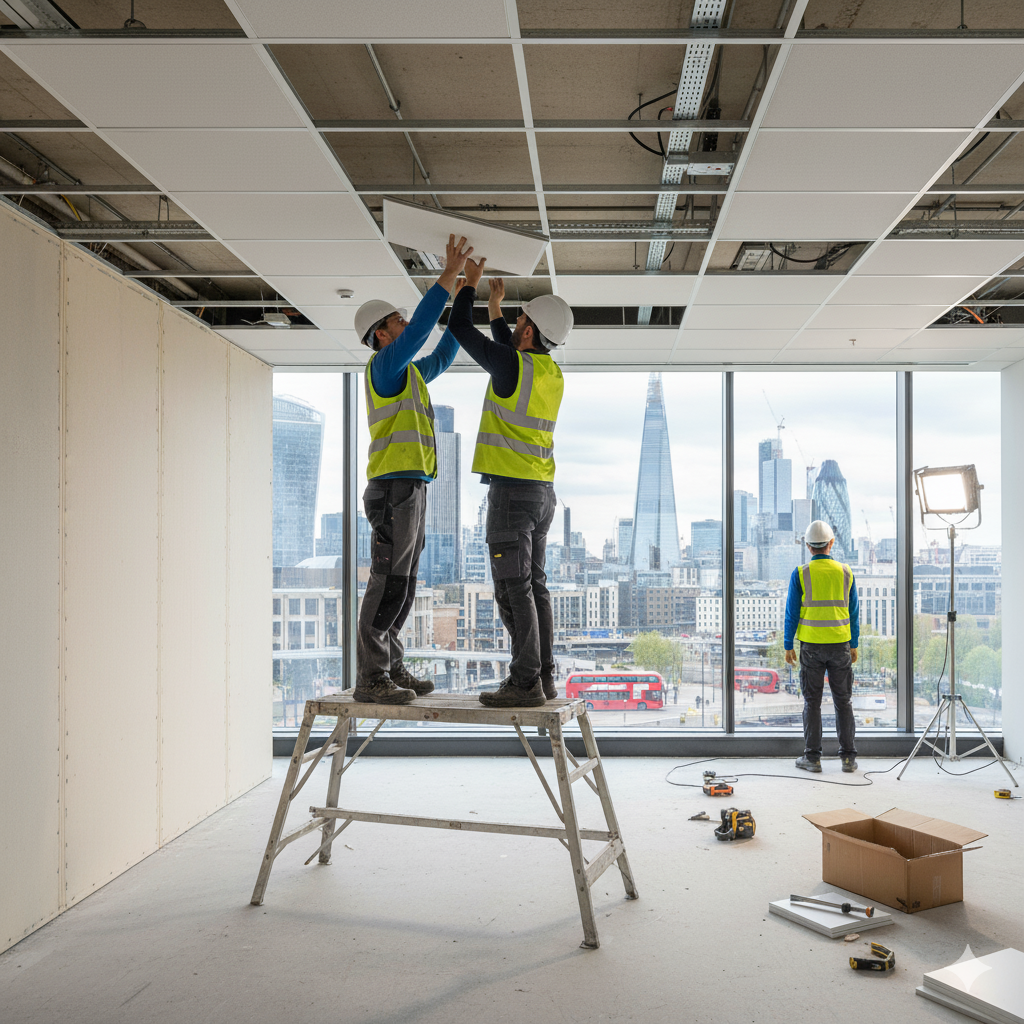
Professional installers use specialised tools and laser levels to ensure every joint is airtight and every board is perfectly aligned. For 2026 projects, we highly recommend hiring expert plant and tools to ensure the finish meets architectural standards.
Common Installation Pitfalls to Avoid
* Bridging the Gap: Accidentally screwing boards through resilient bars and into the studs, which ‘shorts’ the acoustic system.
* Inadequate Sealant: Failing to apply acoustic mastic to the perimeter of the floor, ceiling, and wall junctions.
* Over-tightening: Compressing mineral wool insulation too tightly, which reduces its effectiveness at absorbing sound.
The Cost of Quality in 2026
Material costs in the UK have stabilised, but premium acoustic systems still command a higher price point than standard materials. Expect to pay between £65 and £95 per square metre for a fully installed, high-performance acoustic partition system.
Investing in quality now prevents the need for costly retrofitting later when sound leakage issues inevitably arise. High-grade partitioning also offers superior fire resistance, providing additional safety for your home pod.
Conclusion: Future-Proofing Your Workspace
Mastering acoustic dry lining for home pods 2026 is the key to creating a truly productive and sustainable home environment. By combining soundproof partitioning UK best practices with the latest material innovations, you can ensure your project stands the test of time.
Whether you are expanding via extensions or converting existing space, prioritising acoustics will always pay dividends. Ensure you have the right equipment and expertise on-site to turn your vision into a quiet, efficient reality.