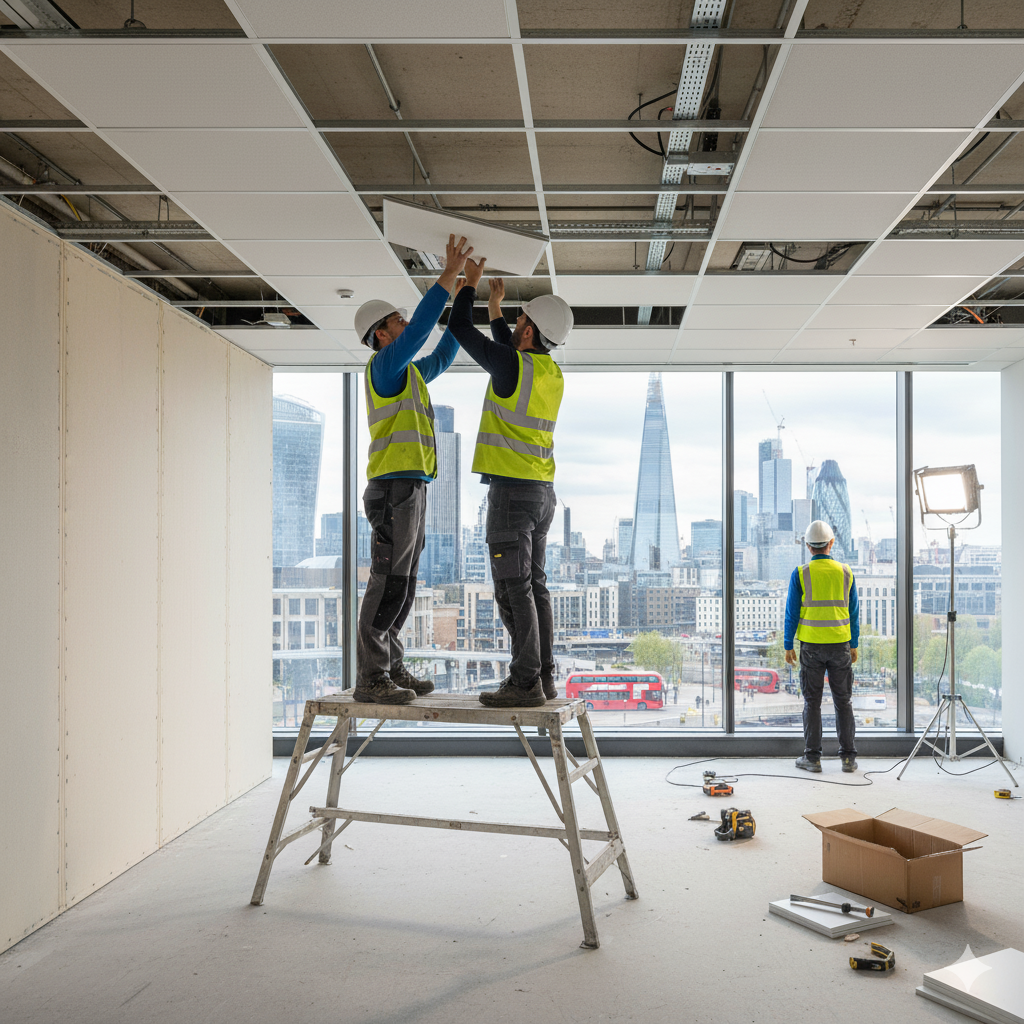



Dry lining—the process of attaching plasterboard to internal walls or metal/timber frameworks—has overtaken traditional wet plastering as the UK’s primary wall-finishing method. In 2026, the advantages are driven by technical precision and the demand for “fast-track” renovations.
1. Meeting 2026 Part L Thermal Standards
With the UK’s commitment to net-zero, internal wall insulation (IWI) is a top priority. Dry lining is the primary vehicle for this upgrade.
-
Insulated Plasterboard: Professional dry liners use PIR-backed boards or phenolic foam boards that significantly lower a room’s U-value.
-
Thermal Bridging: Unlike DIY attempts, professional installation ensures that “cold spots” are eliminated. By 2026, building inspectors require photographic evidence that insulation is continuous, making professional execution essential for certification.
2. Advanced Acoustic Control (Part E)
In the era of hybrid working, “acoustic privacy” is a high-value asset. Partitioning is no longer just about a physical divide; it’s about a decibel barrier.
-
Acoustic Studs and Resilient Bars: Professionals use metal “C-studs” or resilient bars to “decouple” the plasterboard from the structure. This breaks the path of vibration, significantly reducing noise transfer between rooms.
-
High-Density Boards: Specialist blue acoustic boards are far denser than standard grey boards. When installed by a pro with “acoustic sealant” around all perimeters, they can achieve sound reduction levels that meet or exceed Part E of the Building Regulations.
3. Speed, Efficiency, and “Drying-Out” Times
Traditional wet plastering can take days to apply and weeks to fully dry before it can be decorated.
-
Immediate Decoration: Dry lining is a “dry” trade. Once the joints are taped and jointed (or “skimmed” with a thin finish), you can often paint within 24 to 48 hours.
-
Cleaner Site Management: Because it uses significantly less water than traditional plaster, it reduces the risk of moisture-related issues (like condensation or timber swelling) in other parts of the renovation.
Dry Lining vs. Traditional Plastering (2026)
| Feature | Professional Dry Lining | Traditional Wet Plaster |
| Installation Speed | Fast (Hours/Days) | Slow (Days/Weeks) |
| Drying Time | Minimal (Ready in 2 days) | High (2–4 weeks) |
| Acoustic Performance | Excellent (with specialist boards) | Good (Mass-based) |
| Thermal Integration | Seamless (Insulated boards) | Requires separate layers |
| Finish Quality | Perfectly level and flat | Hand-finished (variable) |
4. Fire Safety and Compliance (Part B)
Since the Building Safety Act, fire compartmentation has become a critical focus for UK homeowners, particularly in loft conversions and HMOs (Houses in Multiple Occupation).
-
Fire-Rated Partitions: Professional partitioning systems use pink fire-rated boards containing glass fibres and other additives.
-
Integrity and Insulation: A pro ensures that the partition meets the required “30-minute” or “60-minute” fire resistance. This includes the use of fire-rated downlight covers and intumescent mastic around service penetrations—details often missed in non-professional work.
5. Flexibility and Bespoke Design
Modern dry lining allows for architectural features that were previously too expensive or difficult to achieve with wet plaster.
-
Bulkheads and Alcoves: Professionals can create recessed lighting “coffers,” hidden curtain tracks, and bespoke media walls using metal frameworks and flexible plasterboards.
-
Curved Walls: Using 6mm “flexi-boards,” dry liners can create elegant curved partitions that soften the geometry of a modern apartment or office.
6. Hiding Services and Utilities
The cavity created by a partition wall is the perfect home for 2026 home technology.
-
Future-Proofing: It allows for the hidden installation of Cat6a data cables, smart home sensors, and plumbing for en-suite conversions.
-
Access Panels: Professionals can install “invisible” access panels, allowing you to reach shut-off valves or junction boxes without damaging the aesthetic of the wall.
Final Thoughts
The benefits of professional dry lining and partitioning extend far beyond a smooth finish. In 2026, this trade is the backbone of the “High-Performance Home”—providing the thermal, acoustic, and fire-safety barriers that modern building codes demand. By choosing a professional, you ensure that your walls are not just dividers, but engineered components that add to the comfort and value of your property.
